


Hip replacement surgery has made some great progress over the years and the return to activity can be quite quick compared to other joint replacements such as the knee which is a more complicated one.
During my time as a coach, I have worked with a range of clients that have already had hip replacements as well as clients who were at risk of having a hip replacement but have managed to avoid it through exercise. For the purpose of this blog, I will focus on both my experience and what current research tells us about training after a hip replacement. But before we dive into that, let’s first understand exactly what a hip replacement involves.
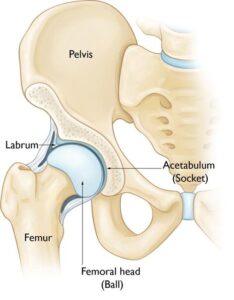
To complete a hip replacement the femoral head is removed and replaced with a metal or ceramic ball (hover the mouse cursor over the image for full view). The ball is secured by a metal stem which is inserted into the femur. Next the hip socket (acetabulum) is removed and a ceramic or polyethylene socket is put in its place. To ensure the ball glides comfortably, a spacer is inserted between it and the new socket which creates a smooth surface.
Prior to May 2010, hip replacements used to consist of both a metal ball and hip socket until further research showed that small metal particles can break down and enter the bloodstream. It is usually recommended that those who have undergone this operation can begin resistance training after 8-12 weeks, however, it is crucial that you’re cleared to do so by your surgeon and physiotherapist beforehand.
A paper published in 2009 by Archives of Physical Medicine and Rehabilitation (found on PubMed) concluded that “early maximal strength training is an efficient treatment for patients who have undergone total hip arthroplasty”. The paper puts a magnifying glass on how a strength training plan can help with the improvement of strength in the hip after surgery. How much you are able to take from this paper and put into practice is based on your strength training background.
For those with no strength training background whatsoever, you will need to get yourself to an appropriate level of strength before you focus on the recommended exercises which the paper quotes are mainly squats and the leg press. The first thing you need to do is assess your range of movement, your brain to muscle connections to exercises and build yourself up slowly to the point where you can do these movements pain free and with good technique.
The average age of someone who has a hip replacement is between 60-80 so if I’m working with a client of this age that does not have a background in strength training, I would have to weigh out the risk to reward of getting that person to squat over using the leg press. In some cases, it may be better to focus on a more controlled movement like a leg press and concentrate on progressing the weight slowly through the program.
Traditional rehab exercises that are recommended to patients after this operation still hold value and work well to complement the big strength movements. Exercises that encourage external rotations in the hip are recommended as well as hip flexor strengthening exercises.
In summary, it is recommended to either start or maintain physical exercise after a hip replacement. Where you start and how you start depends on your exercise background but the goal should be to get to the point where you can do strength training comfortably to aid your recovery.
For any questions on what we’ve covered, complete our enquiry form to arrange an in-person or phone consultation.
And remember…
Evolve or Be Extinct!