


This month’s blog has been written by guest blogger, Chris Brown from Elite Sports | Born Tough.
Fitness enthusiasts leading busy lives are often looking for quick solutions that would help them relieve stress and achieve weight loss goals. With a number of complex moves and workouts to follow, people often lose motivation. Their focus shifts from working out to following the protocol.
Moreover, complex weight loss exercises often require equipment, a visit to the gym, or the supervision of a fitness trainer. According to the World Health Organization, adults aged 18-64 should exercise 150 minutes a week for optimal health and fitness. If you don’t have 150 minutes to dedicate toward your health and fitness, walk to manage these workout minutes and ensure an active lifestyle.
Benefits of Simple Walks & HIIT Walks
Walking is the most overlooked and yet the easiest way to start your fitness journey. According to Garden Robinson, a nutrition specialist working with North Dakota State University Extension Service, “moderate exercise like walking improves mood, strengthens the heart, and reduces the risk of cancer, diabetes, and other diseases.”
Walking can be done anywhere allowing you to add 15-30 minutes of exercise to your day without giving it much thought. Brisk walking to the bus stop and running errands are just a couple of ways to incorporate walking workouts into your busy day.
Some people find walking inadequate and a slow weight loss process. Even if they walk in the mornings and lead an active lifestyle, walking is just not enough for them. And making time for the gym is not an option. In that case, make your regular walks a HIIT workout.
Whether you’re walking around your garden, heading to your friend’s house, or strolling in the park, a HIIT walk is a great way to burn calories fast.
Rate of Perceived Exertion (RPE) for HIIT Walks
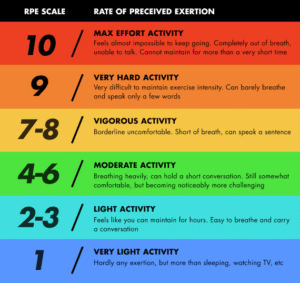
For brisk walks and HIIT workouts, a rate of perceived exertion chart (RPE) is an easy way to measure the intensity of the workout and your progress. At the beginning, you may not be able to achieve higher RPE ratings, but this would improve over time as you develop cardiovascular strength and stamina.
How to HIIT Walk?
Simply combine 60-second intervals of brisk and slow walking to convert simple walks into a rigorous HIIT walking workout.
Warm-Up – 5 Minutes
Just like any other exercise, always start your walks with a warm-up. Whether you perform HIIT walk workouts and walk briskly, warm-ups improve blood and oxygen supply to the muscles, ensure efficient movement, and reduce the risk of muscle strains. Slow walking for five minutes at a 2-3 RPE rating makes for a great warm-up.
Main Workout – 5 – Minutes
- Walk Vigorously for 3 Minutes
Walk at a moderate speed to get your heart and breathing rate up, but you should still be able to talk and not feel a burning sensation in your lungs. Pick up speed until your breathing becomes uncomfortable. On an RPE chart, your rating should gradually increase from 4-7 during this interval.
- Brisk Walk for 1 Minute
Walk as fast as possible. While walking, talking will become difficult. Try to maintain the intensity for 60 seconds and stop when it feels impossible to go on. During this interval, your RPE rating should be an 8 or above.
- Moderate Walk for 1 Minute
Slowly decrease your pace to a moderate walk. You would still feel shortness of breath but maintaining pace would become easier. The ideal RPE rating for this interval is 4-6.
Cool Down – 4 Minutes
Walk slowly at a comfortable pace. For a cool-down session, your RPE rating should not exceed level 3. At this pace, you can easily speak or sing out loud while walking.
Rest – 1 Minute
If you plan to perform the next rep, it is best to pause for 60 seconds. Otherwise, increase your cool-down session to 5 minutes.
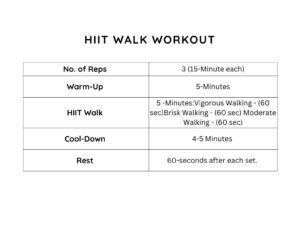
You can perform three reps in one go, or at different times throughout the day. In the beginning, make sure you time yourself so as not to prolong your high-intensity intervals.
Unlike simple walks, HIIT walking workouts should not be performed daily. Keep these workouts only for busy days. In case you find yourself unable to take out time for your regular gym workouts, alternate HIIT walks with simple walks to prevent overdoing it.
Takeaway
HIIT walking has proven health benefits and can help you achieve your fitness goals fast. During busy schedules, when going to the gym and following a proper workout is not possible, a HIIT walk will help you stay active and add the 30-minute increments every day to the 150-minute weekly physical activity.
The key is to make the best of every opportunity you get to walk. In the beginning, start slowly to warm up and then alternate between brisk and slow walking. Do not perform a HIIT walking workout every day. Keep them for days when you don’t have time to dedicate to the gym.
If you want, you can also incorporate HIIT walks into your gym workout routines. HIIT walk is easy to perform on a treadmill. With a number of videos available on YouTube, you can enjoy a variety of HIIT and simple walk workouts.